
Today we met with Luigina to sponge off her excellent skills and knowledge in evaluation techniques.
During the course of study, we were mainly focused on evaluating systems with user interfaces, usually GUI's. We knew that the same sort of techniques would not necessarily apply to our project. Before speakimg to Lui we were looking at undertaking a heuristic evaluation (evaluating the prototype with a number of chosen experts, based on set design principle criteria).
Lui advised that Heuristic Evaluation applies essentially to user interfaces, and that our instrument prototype bares no relationship to the type of criteria involved.
As our project is very much exploratory, it would be best to take a loose informal approach. The following approach suggested by Lui would be best:
*Choose 5 to 6 test subjects, that fit our various user profiles.
*Conduct an informal walkthrough of the prototype, showing it's various functionalities.
*Prepare a number of questions that search for what we need to find out. i.e. How do you feel these functions are an improvement on existing instruments?
*Maintain an informal discussion, dropping subtle hints that keep the feedback on course.
*Don't dwell on information that not important for what we need to know.
*Document techniques, notetaking, dictaphone, video.
*Stay away from questionnaires!
Lui advised that this can be conducted after aug 24th if prototype isn't ready.
She recommended however, that we document, what, why, who and how we want to evaluate.
Thanks Lui
Showing posts with label Meetings with.... Show all posts
Showing posts with label Meetings with.... Show all posts
Wednesday, August 22, 2007

Meeting with Annette Aboulafia - Aug 14th
Annette Aboulafia, researcher in the IDC, kindly proof read our draft report for us. Afterwards we met to discuss it.
Annette helped us to clearly define our aims and objectives. Although we know them, it's not always easy to explain them to other people. We also learned that it's important to know the scope of the project. For example, is the prototype a learning device? Answer: No.
In terms of the report, she offered the following suggestions.
*Begin the Introduction chapter with an introductions to the field of study.
*Give a brief description of each project member's background and interests.
*Give an introduction to the research section. i.e. research questions, what we researched and why.
Thanks Annette!
Annette helped us to clearly define our aims and objectives. Although we know them, it's not always easy to explain them to other people. We also learned that it's important to know the scope of the project. For example, is the prototype a learning device? Answer: No.
In terms of the report, she offered the following suggestions.
*Begin the Introduction chapter with an introductions to the field of study.
*Give a brief description of each project member's background and interests.
*Give an introduction to the research section. i.e. research questions, what we researched and why.
Thanks Annette!
Thursday, August 9, 2007
Meeting with Mikael 7th August
On Aug 7th we met with Mikael to discuss the progress of our prototype. We gave him a quick demo and identified difficulties and further work.
The main points of the meeting were as follows:
- On subject of Threshold and its inconsistency, Mikael suggested that we try and retrigger the condition in Arduino code rather than Max/Msp.
Or possibly try to induce "Temporal Hysteresis" (needed when there is wide signal variations, such as smacking a marimba mallet at various velocities)
-Mikael suggested we try to improve bouncing of sound on the Arduino code side.
-In addition to this, Mikael suggested affixing a 10 nK (nanoFarads) CAPACITOR to the resistor and Piezo wire in order to take out the high frequencies. this effectively acts as a low pass filter for the signal.
-finally, as opposed to using static wav/aif files as sounds, the other future option is to develop sound models, Putting an ADSR envelope (ATTACK DECAY SUSTAIN RELEASE) is a useful approximation of the volume of REAL instrument (but not always a substitute)
-We were also encouraged to use pd rather than max/msp, as it is open source.
ls dev in a mac terminal tell what serial port is being occupied. This will hopefully fix connectivity problem with PD
The main points of the meeting were as follows:
- On subject of Threshold and its inconsistency, Mikael suggested that we try and retrigger the condition in Arduino code rather than Max/Msp.
Or possibly try to induce "Temporal Hysteresis" (needed when there is wide signal variations, such as smacking a marimba mallet at various velocities)
-Mikael suggested we try to improve bouncing of sound on the Arduino code side.
-In addition to this, Mikael suggested affixing a 10 nK (nanoFarads) CAPACITOR to the resistor and Piezo wire in order to take out the high frequencies. this effectively acts as a low pass filter for the signal.
-finally, as opposed to using static wav/aif files as sounds, the other future option is to develop sound models, Putting an ADSR envelope (ATTACK DECAY SUSTAIN RELEASE) is a useful approximation of the volume of REAL instrument (but not always a substitute)
-We were also encouraged to use pd rather than max/msp, as it is open source.
ls dev in a mac terminal tell what serial port is being occupied. This will hopefully fix connectivity problem with PD
Tuesday, July 17, 2007
Meeting with Mikael - July 12th
For this meeting we met in the IDC lab.
Mikael gave us fsrs to use but we were not quite sure how to connect these to the arduino as they had no wires, only adhesive backs (used for Ztiles project). We felt it could be complicated to do this so we decided to stick with using Piezos. On testing the Piezos we felt they had sufficient sensitivity. Marc McLoughlin used these on his thesis artefact last year so we have someone with experience who could offer us advice. Mikael mentioned it's just a matter of adjustment(such as tweaking threshold) to get the right response from the sensors. He advised we test outputting sounds with two sensors before we go any further. He also advised that 8 sensors on the one arduino may require we lower the threshold value. Only after 8 sensors working fine off the one arduino should we start to build the physical surroundings for the instrument.
We showed Mikael the wooden prototype Dave put together to give an ideas of ahape and dimensions.
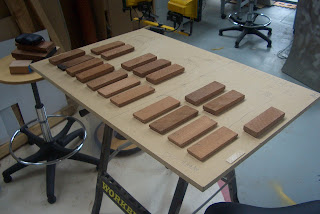
Mikael recommended possibly using an adhesive lino backing for the instrument(similar to Ztiles approx 3mm thick, to absorb the pressure), and also placing a strip of adhesive lino over each sensor. He warned that hitting one bar could trigger a sensor from a different bar.
Major advice from meeting - start outing sounds from sensor hits asap!
Mikael gave us fsrs to use but we were not quite sure how to connect these to the arduino as they had no wires, only adhesive backs (used for Ztiles project). We felt it could be complicated to do this so we decided to stick with using Piezos. On testing the Piezos we felt they had sufficient sensitivity. Marc McLoughlin used these on his thesis artefact last year so we have someone with experience who could offer us advice. Mikael mentioned it's just a matter of adjustment(such as tweaking threshold) to get the right response from the sensors. He advised we test outputting sounds with two sensors before we go any further. He also advised that 8 sensors on the one arduino may require we lower the threshold value. Only after 8 sensors working fine off the one arduino should we start to build the physical surroundings for the instrument.
We showed Mikael the wooden prototype Dave put together to give an ideas of ahape and dimensions.

Mikael recommended possibly using an adhesive lino backing for the instrument(similar to Ztiles approx 3mm thick, to absorb the pressure), and also placing a strip of adhesive lino over each sensor. He warned that hitting one bar could trigger a sensor from a different bar.
Major advice from meeting - start outing sounds from sensor hits asap!
Saturday, June 23, 2007
Meeting with Mikael - June 23rd
Back from the Siena Design Project exhibition, distractions behind me, raring to go....I touched base with Mikael Fernstrom. Not much activity in recent weeks, what I had done was develop a clearer objective(or brief) for the thesis: 'An Exploration of ways in which Interactive Media Technology can enhance the capabilities of a Traditional Musical Instrument'. One thing Siena taught me is that clearly undertanding a project's objective and scope is very important. Also spoke to Fillippo Fano (contemporary muscian) about functionality suggestions.

Meeting with Mikael began with Mikael explaining the notion of resonators on a vibraphone; to create a much stronger standing wave and amplify the fundamental frequency of the sound produced. He also mentioned the presence of a rotating disk at the top of each resonator. As the disk rotates, a vibrato or wah wah effect is created.
He also mentioned using the 5 notes per octave rather than the traditional 12, as well as possibly having an option of playing a musical instrument in reverse.

He gave me a list of research material.
Bob Moog - dvd - "Moog" a documentary film by Hans Fjellstad.
Don Buchla i.e. Marimba Lumina
Joe Paridiso
Hiroshi Ishii
Tod Machover's 'Brain Opera'
'Gravichords, Whirlies, and Pyrophones - Experimental Musical Instruments' - Bart Hopkin
'Experimental Musical Instrument Journal' - Library
We then discussed technology - piezo sensors and fsrs force sensing resistors
Mikael recommended fsrs as they're more sensitive than piezos, and also connecting many arduinos to these, depending on how many inputs.
We also discussed alternative technologies such as touchscreen(Nora's project) or a novel projected QWERTY keyboard Mikael has in his office(limited). I said I like to understand how to use sensors and arduinos coupled with PD.

Mikael then explained to me how to simply connect fsrs or piezos to an arduino board (dont forget 10K resistors for each sensor!)


Goal for this week:
Compose sounds in PD.
Connect sensors to Arduino and output sounds through PD.
Note: Mikael is away in Canada til July 2nd.

Meeting with Mikael began with Mikael explaining the notion of resonators on a vibraphone; to create a much stronger standing wave and amplify the fundamental frequency of the sound produced. He also mentioned the presence of a rotating disk at the top of each resonator. As the disk rotates, a vibrato or wah wah effect is created.
He also mentioned using the 5 notes per octave rather than the traditional 12, as well as possibly having an option of playing a musical instrument in reverse.

He gave me a list of research material.
Bob Moog - dvd - "Moog" a documentary film by Hans Fjellstad.
Don Buchla i.e. Marimba Lumina
Joe Paridiso
Hiroshi Ishii
Tod Machover's 'Brain Opera'
'Gravichords, Whirlies, and Pyrophones - Experimental Musical Instruments' - Bart Hopkin
'Experimental Musical Instrument Journal' - Library
We then discussed technology - piezo sensors and fsrs force sensing resistors
Mikael recommended fsrs as they're more sensitive than piezos, and also connecting many arduinos to these, depending on how many inputs.
We also discussed alternative technologies such as touchscreen(Nora's project) or a novel projected QWERTY keyboard Mikael has in his office(limited). I said I like to understand how to use sensors and arduinos coupled with PD.

Mikael then explained to me how to simply connect fsrs or piezos to an arduino board (dont forget 10K resistors for each sensor!)


Goal for this week:
Compose sounds in PD.
Connect sensors to Arduino and output sounds through PD.
Note: Mikael is away in Canada til July 2nd.
Sunday, April 29, 2007
Meeting with Mikael - Tue 30th April 11am
A meeting with Mikael Fernstrom was arranged for 30th April.
Issues to address were as follows
1. Novel custom interface rather than keyboard-like. ie. Paper or Cardboard cut out.
2. Extra scope - slide mallet to increase/decrease pitch,octave,whatever.
3. Emperical research - Micheal O Suilleabhain, Evelynn Glennie(Killarney July 12th, 13th, 14th), blind musician ie Stevie Wonder;)
4. Arduino for prototype
5. Tutorials for Max/MSP, PD, VVVV.
6. Performance Space/3 way projector?
7. Concerns - latency - 10mm - last year's could only achieve 30mm
Results of meeting:
*Mikael advised us to looked much further into novel devices (NIME-http://www.nime.org/)
*The term 'Acousmatic Music'
*Manifesto - softday.ie
The likely interconnectedness of all things impossible,
the sound of blue,
the shape of air,
the colour of silence,
the aroma of Bb,
in the tempo of Pi,
*John Cage - music in relation to visual art
*Max Matthews - radio baton
*Gary Burton garyburton.com
*Øyvind Brandtsegg kroyt.com
*Aftertouch - To avoid confusing, pressure sensitivity with velocity sensitivity, pressure sensitivity is sometimes called aftertouch.
*Mikael recommends we use PD and GEM
*Mikael will be out of country until around 16th May. He'll then give us a lecture on PD.
*We also discussed a semi-dome shaped screen surrounding the performance area.
Issues to address were as follows
1. Novel custom interface rather than keyboard-like. ie. Paper or Cardboard cut out.
2. Extra scope - slide mallet to increase/decrease pitch,octave,whatever.
3. Emperical research - Micheal O Suilleabhain, Evelynn Glennie(Killarney July 12th, 13th, 14th), blind musician ie Stevie Wonder;)
4. Arduino for prototype
5. Tutorials for Max/MSP, PD, VVVV.
6. Performance Space/3 way projector?
7. Concerns - latency - 10mm - last year's could only achieve 30mm
Results of meeting:
*Mikael advised us to looked much further into novel devices (NIME-http://www.nime.org/)
*The term 'Acousmatic Music'
*Manifesto - softday.ie
The likely interconnectedness of all things impossible,
the sound of blue,
the shape of air,
the colour of silence,
the aroma of Bb,
in the tempo of Pi,
*John Cage - music in relation to visual art
*Max Matthews - radio baton
*Gary Burton garyburton.com
*Øyvind Brandtsegg kroyt.com
*Aftertouch - To avoid confusing, pressure sensitivity with velocity sensitivity, pressure sensitivity is sometimes called aftertouch.
*Mikael recommends we use PD and GEM
*Mikael will be out of country until around 16th May. He'll then give us a lecture on PD.
*We also discussed a semi-dome shaped screen surrounding the performance area.
Subscribe to:
Posts (Atom)
